Celijia logo
All products
Weighing & Overload Protection · HDC2000 / HDC2001D

Dual Weighing System (Power-Analysis Sensor + Traditional Sensor)

A redundant two-channel weighing solution that pairs the Celijia Intelligent Power-Analysis Sensor with conventional load-pin (strain-gauge) sensors. Cross-validated, SOLAS-ready container weighing.

Request data sheet

Overview

The Dual Weighing System combines the Celijia Intelligent Power-Analysis Sensor with conventional load-pin (shear-beam) sensors so the two channels can validate each other in real time. This redundancy is targeted at the highest-stakes safety functions on STS and RMG cranes, where the SOLAS Convention requires strict container-weight accuracy.

The two channels feed unified weight, imbalance and torque data to the PLC through a single interface. If either channel fails, the system automatically falls back to the remaining channel and raises a fault indication — the crane can keep operating safely until the next maintenance window.

The power-analysis channel also performs online auto-zero correction on the traditional sensor, dramatically slowing the zero-drift that traditional load-pin sensors normally suffer from and extending their service life. Field deployments at Tianjin Alliance (33 RTGs) and Qingdao New Qianwan (34 RMGs) demonstrated 5 % faster light-container handling and 5 % energy savings.

Key features

  • Dual channels: Intelligent Power-Analysis Sensor + traditional load-pin sensor
  • Real-time cross-validation between the two channels — accuracy ≤ 2 %
  • System reliability up to 99.999 %
  • Three operating modes: dual / sensor-only / power-analysis-only
  • Power-analysis channel continuously auto-calibrates the traditional sensor
  • Container imbalance detection (left–right, front–rear)
  • SOLAS-compliant container weight output to PLC
How it works

Architecture & operating modes

Schematic illustrations showing where the system sits in the crane control loop and how it behaves under each fault scenario.
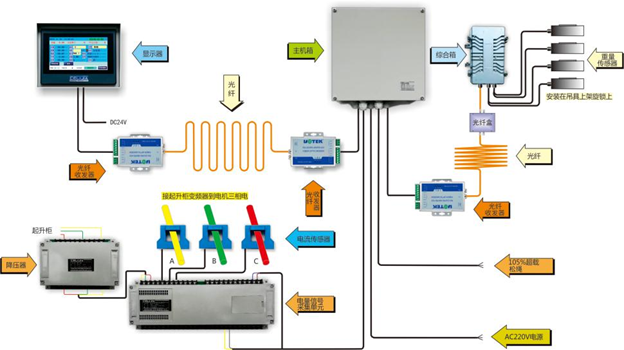
Celijia Dual Weighing System full wiring diagram — main cabinet, current sensors on the motor phases, voltage step-down module, fiber-optic link, operator display, load cells and AC220V supply.
Full system wiring — current sensors clamp around the three hoist-motor phases and traditional load cells are read in parallel. The voltage step-down module conditions the line voltage; both signal streams travel over a fiber link to the main cabinet, which serves the operator display and outputs alarms / weight to the crane PLC.
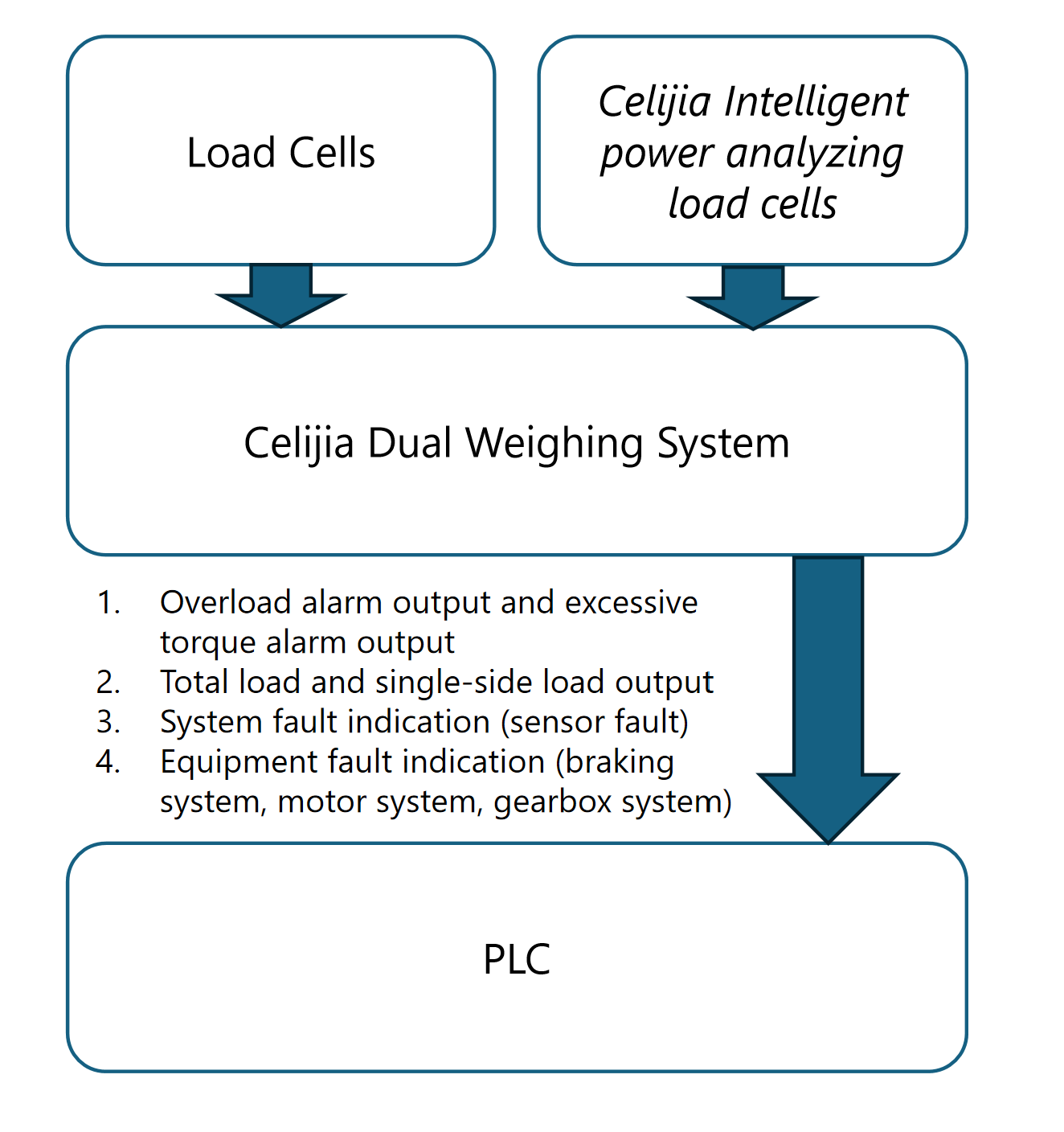
Celijia Dual Weighing System architecture — load cells and IPA sensors feeding a unified main cabinet that outputs to the PLC.
System architecture — both Celijia Intelligent Power-Analysis sensors and traditional load cells feed the Dual Weighing System main cabinet, which forwards overload alarms, total / single-side weights, sensor faults and equipment-fault indications to the crane PLC.
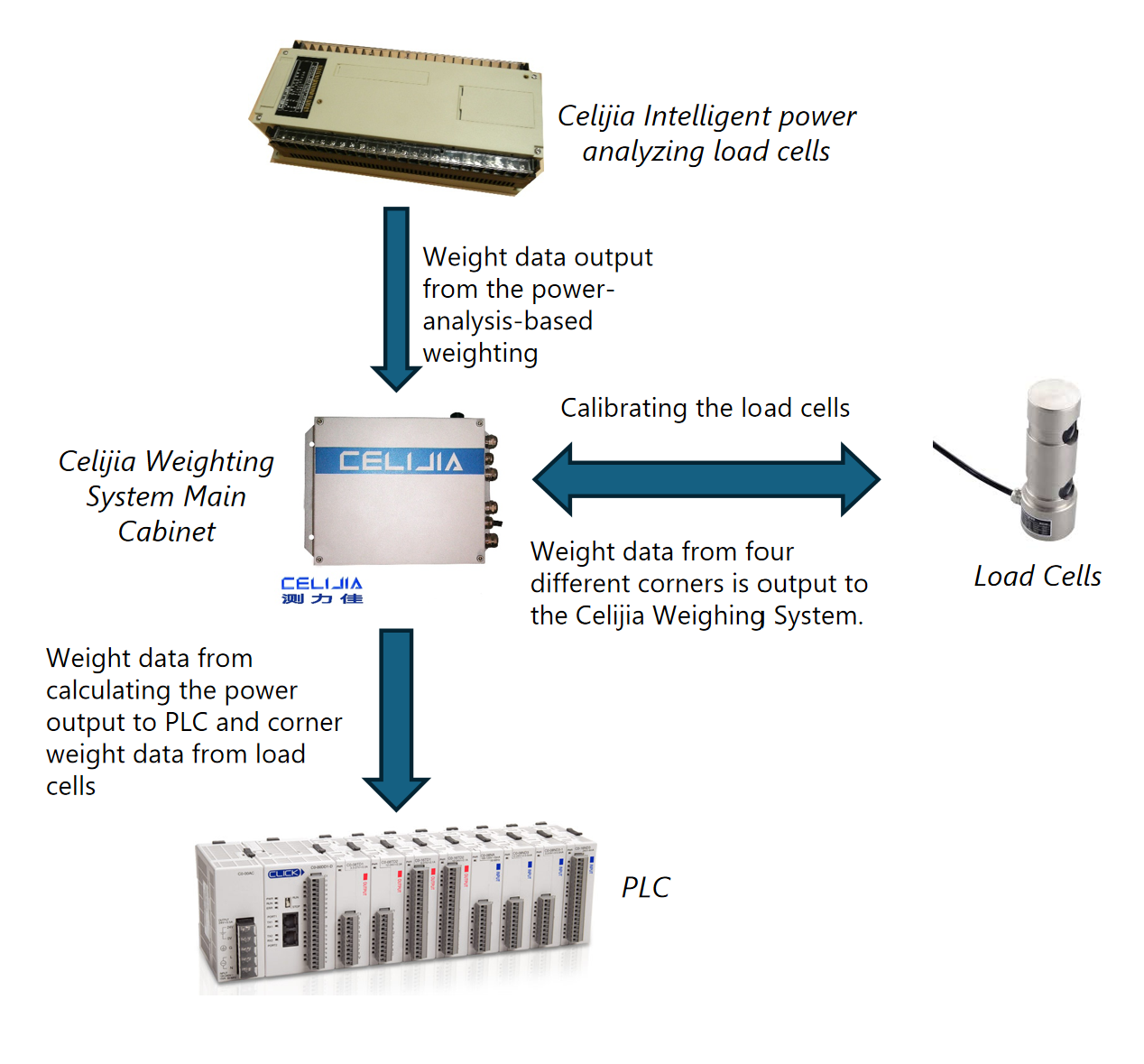
Normal operating mode — both channels active, with cross-validation between IPA and load cells.
Mode 1 · Normal operation — the IPA sensor outputs power-analysis-based weight while load cells stream four-corner readings. The two channels cross-validate each other and the IPA continuously calibrates the load cells in real time.
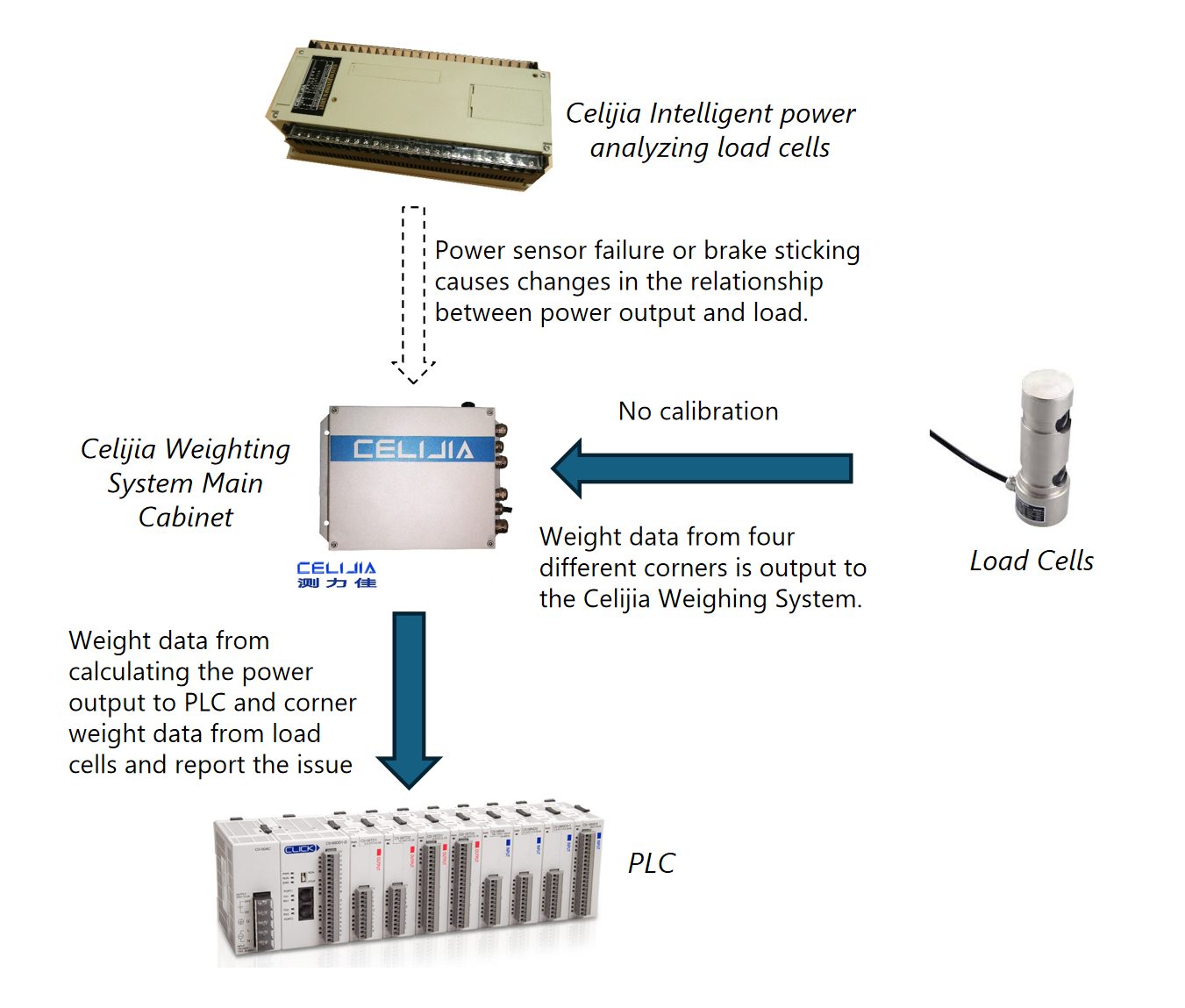
Power-analysis channel fault — system falls back to load-cell-only operation and reports the fault.
Mode 2 · Power-analysis channel fault — when sensor drift or brake sticking corrupts the power/load relationship, the system seamlessly falls back to the load-cell channel without re-calibration and reports the IPA fault to the PLC.
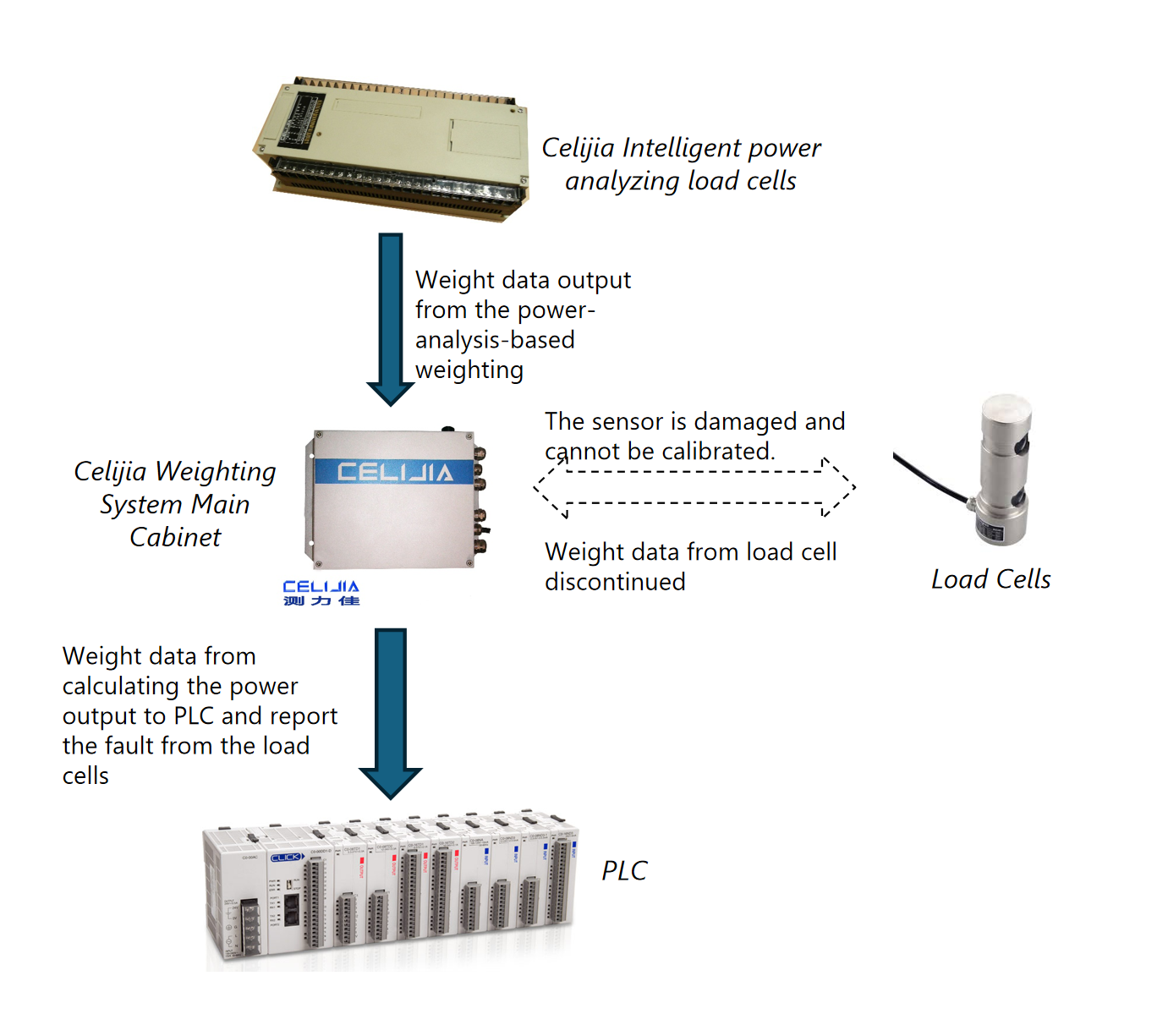
Load-cell channel fault — system continues using the IPA sensor and reports the load-cell fault.
Mode 3 · Load-cell channel fault — when a load cell is damaged or can no longer be calibrated, the load-cell stream is suspended; the IPA sensor continues to deliver weight to the PLC and the load-cell fault is reported.