Intelligent Power-Analysis Overload Protection System
A complete overload-protection system built on the Intelligent Power-Analysis Sensor. Deployed standalone (without any traditional load sensor) on STS, RTG and RMG cranes worldwide.
Request data sheetOverview
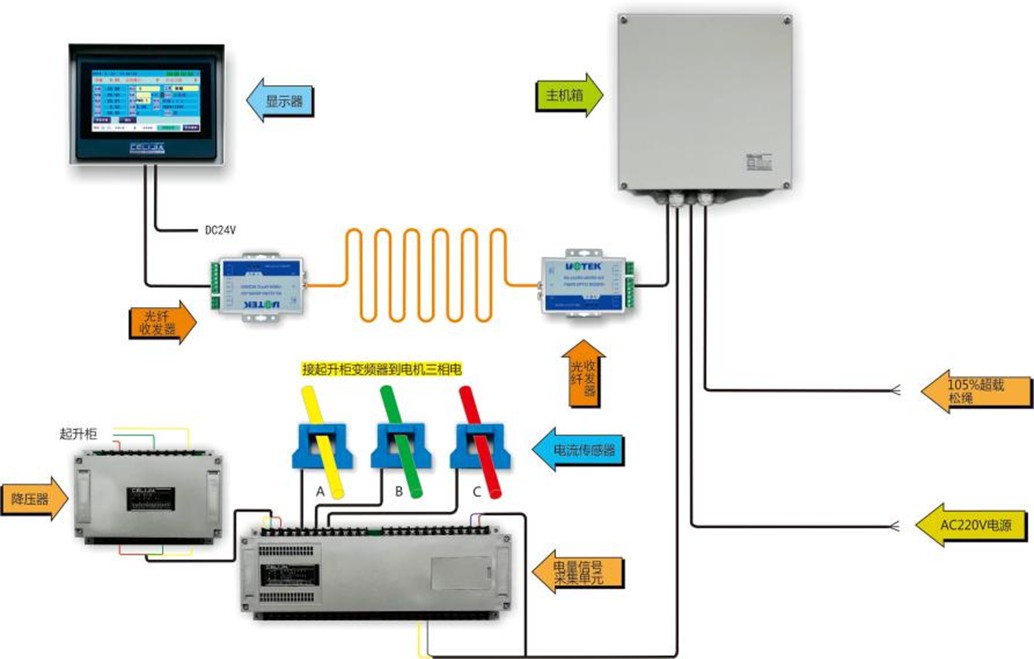
The HDC2100 is the productized form of the Intelligent Power-Analysis Sensor for container-crane overload protection. It acquires hoisting-motor current and voltage through current and voltage transformers, computes motor torque and lifting load in real time, and outputs alarm and protection signals to the crane PLC.
Because no mechanical sensor is in the load path, the costly cycle of frequent calibration, sensor replacement and crane downtime simply disappears. Customers typically save more than 75,000 CNY per crane in maintenance and calibration cost over a 10-year period.
Compatible with all electrically driven lifting equipment — STS, RTG, RMG, mobile harbour cranes, straddle carriers and reach stackers — and deployable without any modification to the existing mechanical structure.
Key features
- Powered by the Celijia Intelligent Power-Analysis Sensor
- No mechanical load sensors required
- Overload alarm response < 1 s
- Five-year calibration-free operation, accuracy error < 3 %
- False-alarm rate < 0.001 %
- 20 MB on-board load-data storage; complete historical event logging
- 10-year cost saving > 75,000 CNY per crane vs. sensor-based solutions
Architecture & operating modes
Schematic illustrations showing where the system sits in the crane control loop and how it behaves under each fault scenario.